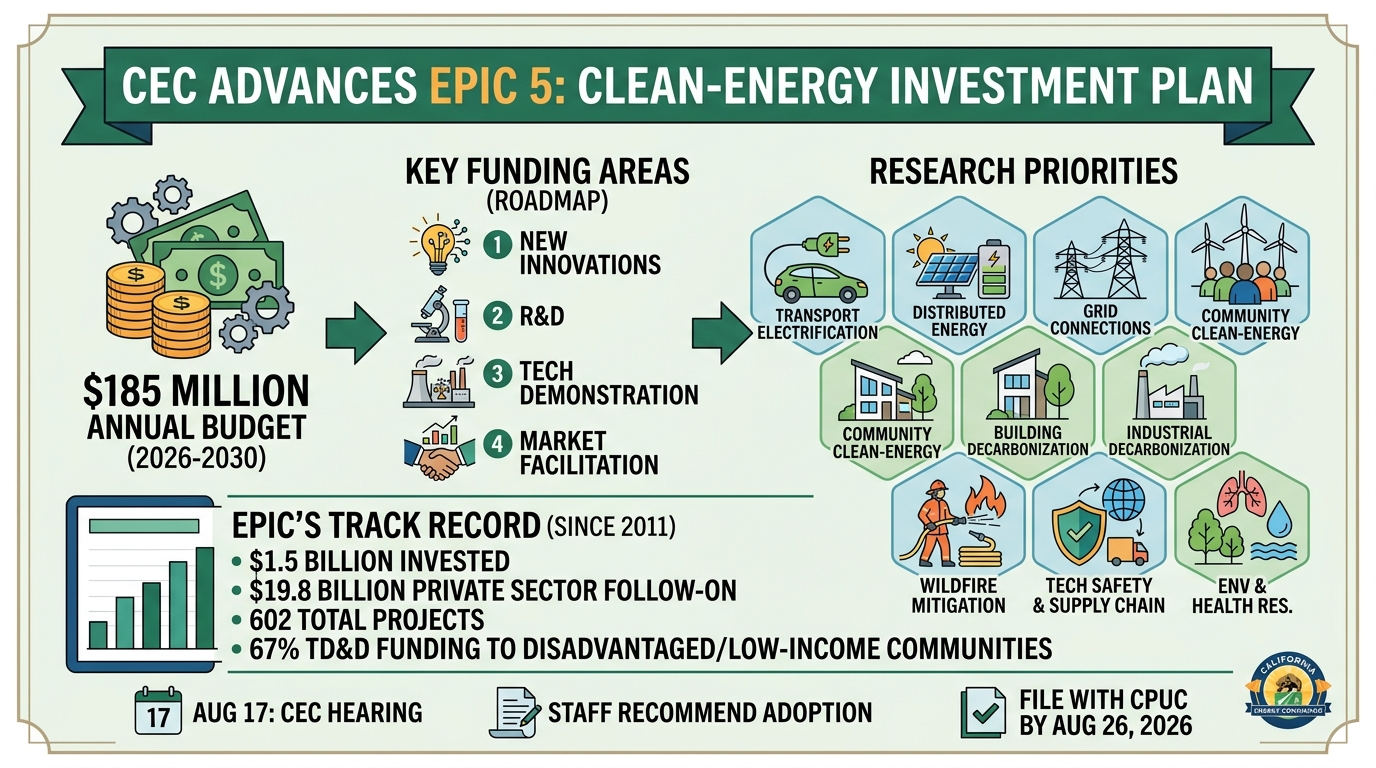
The California Energy Commission’s June 22 business meeting materials show the agency approving or advancing four large technology demonstrations under its EPIC and INDIGO programs, spanning microgrid controls, smart-meter grid mapping, flexible data-center interconnection and industrial heat electrification.
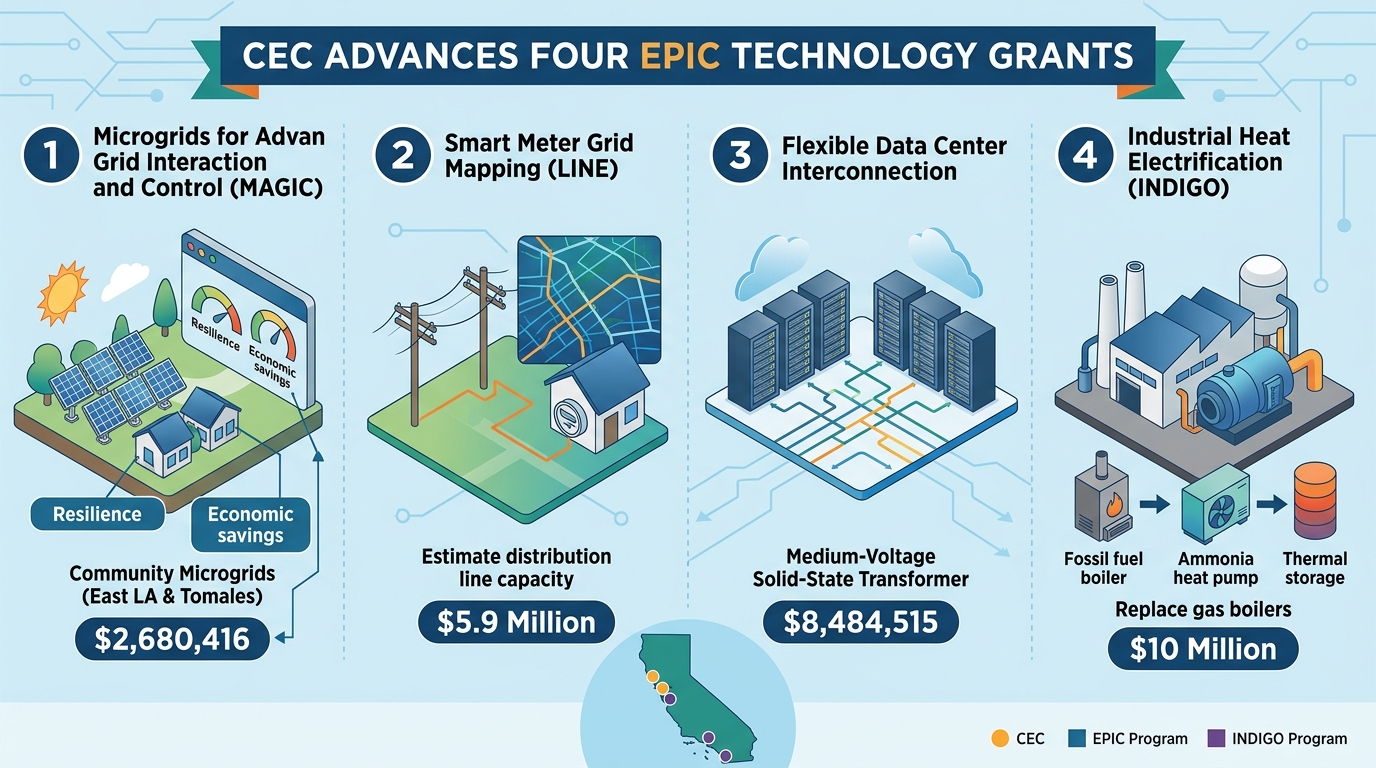
The commission approved Agreement EPC-25-051 with New Sun Road, P.B.C., for a $2,680,416 EPIC grant to develop advanced microgrid controls for two existing community microgrids in East Los Angeles and Tomales. The project, titled MAGIC — Microgrids for Advanced Grid Interaction and Control, is intended to help microgrids provide grid services while improving resilience and economics, according to the meeting packet.
CEC staff also recommended approval of Agreement EPC-25-055 with Lawrence Berkeley National Laboratory for a $5.9 million EPIC grant. That project would develop the Line Impedance Network Estimator, or LINE, a smart-meter-based grid-mapping tool meant to estimate secondary distribution line capacity and topology.
In a separate item, the commission proposed approving Agreement EPC-25-054 with The Regents of the University of California on behalf of UC San Diego for an $8,484,515 EPIC grant. The project would demonstrate a medium-voltage solid-state transformer system for flexible interconnection of an 800-volt direct current data center architecture, while also developing a tool to help utilities model and manage large data-center loads.
For industrial electrification, staff recommended approving a $10 million INDIGO grant for DC Energy Services LLC dba Imperion to electrify process heat at a City of Industry facility. The packet says the project would replace fossil gas-fired boilers with an ammonia heat pump, waste heat recovery and thermal energy storage, but the materials provided here do not establish whether the commission took final action on that item at the meeting.
Taken together, the items point to where the commission is focusing a slice of its applied technology spending: controls software, distribution-grid visibility, flexible load interconnection and industrial emissions cuts. The New Sun Road, LBNL and UC San Diego items were backed by primary meeting materials; the Imperion item is reported here as a staff recommendation only.