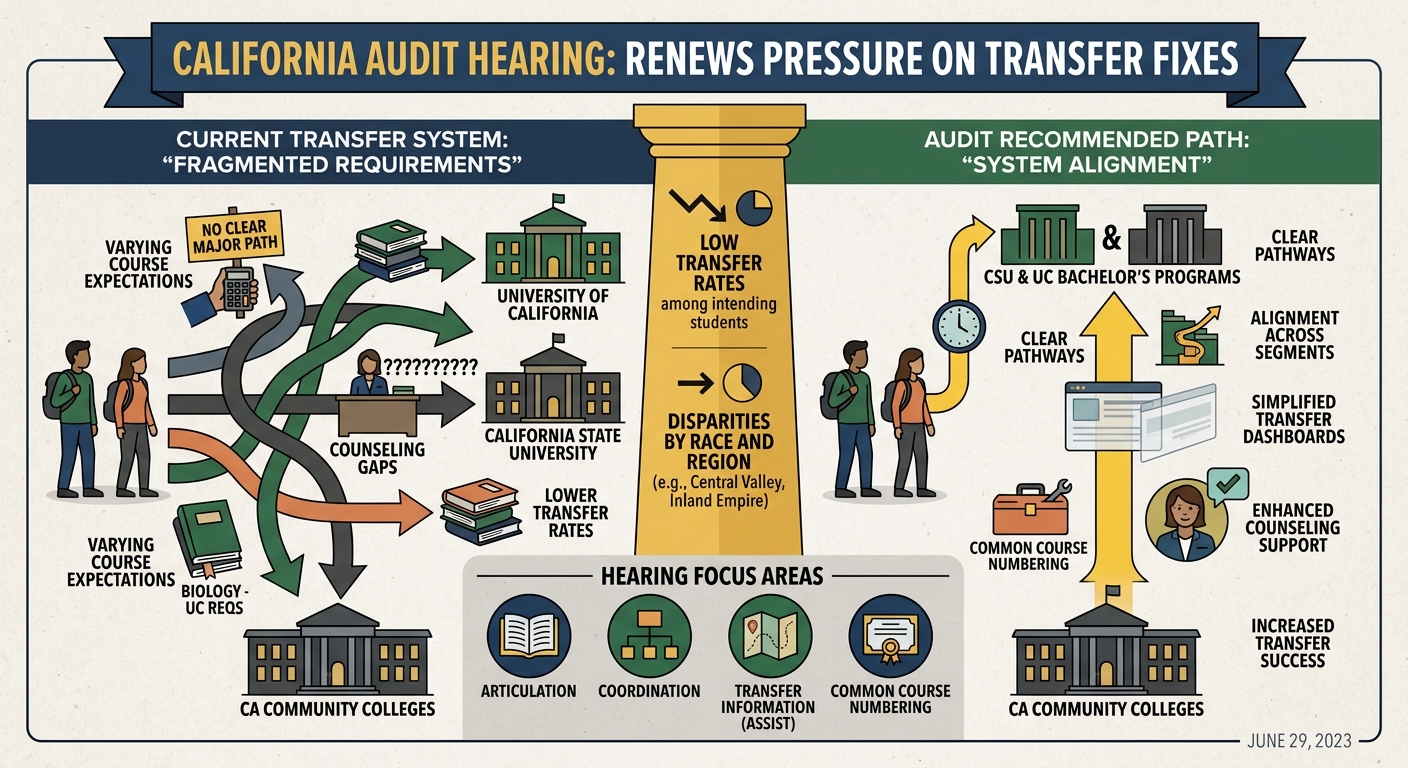
A Joint Legislative Audit Committee hearing on June 29 put California’s community college transfer system back in the spotlight as lawmakers and higher-education leaders revisited a 2023 state audit that said fragmented requirements make it harder for students to move into University of California and California State University bachelor’s programs.
According to the hearing summary and related materials, the auditor told lawmakers that the core problem is not access to higher education alone, but the lack of alignment among campuses, majors and systems. The audit found wide variation in transfer requirements, especially in STEM fields, and said students can face different course expectations depending on which campus they are targeting.
The record also shows speakers discussed low transfer rates for students who intend to transfer, along with disparities by race and region. The summary says the auditor described transfer-intending students who never apply because they lack enough units, do not know which courses will count, or do not have enough counseling support. It also says speakers cited weaker transfer outcomes in places such as the Central Valley, Inland Empire and some northern regions of the state.
UC, CSU and community college representatives defended the steps they have taken since the audit, including new dashboards, transfer pathways and data-sharing efforts, while acknowledging that more coordination is needed. The hearing summary says legislators pressed the systems on articulation, common course numbering, counseling and making transfer information easier to find on ASSIST.
The available record does not show any formal committee vote or action. It also does not provide the full transcript needed to quote the most specific exchanges or confirm whether lawmakers issued any follow-up directive.
The hearing comes as lawmakers and higher-education leaders continue broader discussions about transfer transparency and system alignment across California’s public college segments.